
Nicotine Cessation Tips
Cold turkey nicotine dependency recovery tips to help you quit smoking cigarettes, stop vaping e-cigs, or end smokeless tobacco use.
WARNING: The below tips are NOT MEDICAL ADVICE. Contact your physician should you experience ANY condition or symptom that causes you or loved ones concern or alarm, including continuing depression.
- Law of Addiction - The law of addiction states, "administration of a drug to an addict will cause re-establishment of chemical dependence upon the addictive substance at the old level of use or greater." Yes, just one puff and you'll be faced with again enduring up to 72 hours of nicotine detox. We're not that strong. Adherence to a simple restatement of the law of addiction guarantees success to all. No nicotine just one day at a time ... to Never Take Another Puff, Vape, Dip or Chew. (video)
- Be Honest With Yourself - We are "REAL" drug addicts. The wanting and urges you feel for more nicotine flow from the same brain dopamine pathways as the wanting felt by the alcoholic, and the heroin or methamphetamine addict. And nicotine dependency is every bit as real and permanent as alcoholism. Why play games with yourself? Treating a true addiction as though some nasty little habit is a recipe for relapse. There is no such thing as just once. Recovery truly is all or nothing. (video)
- See Cheating as Failure - Brain imaging studies teach us that just one puff and up to half of brain dopamine pathway receptors become occupied by nicotine. While most walk away from "cheating" feeling like they have gotten away with it, it isn't long before they find their brain wanting, plotting to obtain or even begging for more. Don't fall prey to the tease of "just one" or "just once." You're smarter than that. (video)
- Repeat After Me - My name is ________ and I'm a REAL drug addict. Let's say it again and this time say it and mean it with every fiber of your being. My name is _________ and I am a nicotine addict. While I can fully and comfortably arrest my dependency, I cannot cure or kill it. On lifetime probation, my brain will always remain grooved and wired for relapse. The only remaining question is, on which side of dependency's bars will I spend the balance of life? (video)
- Quit Cold Turkey - Contrary to pharmaceutical industry marketing hype, it's how most nicotine addicts successfully arrest their chemical dependence. But don't take our word for it. Quoting from page 15 of the Surgeon General's 700-page 2020 "Smoking Cessation" report, "most smokers who quit successfully do so without medications or any type of formal assistance" and "cold-turkey quitters do as well or better than those who use over-the-counter NRTs." Trust in your natural instincts. Cold turkey is fast, safe, productive, effective and free. (video)
- Leave Replacement Nicotine Alone - While we likely know someone who succeeded in weaning themselves off of nicotine, if unsupported, it's not nearly as easy as we've been led to believe. Frankly, the pharmaceutical industry has been less than honest about "your chances" while using nicotine replacement products (NRT) such as the patch, gum and lozenge. For example, after 30 years and billions spent marketing Nicorette, a July 2013 U.S. Gallup Poll found that only 1 in 100 successful ex-smokers credited nicotine gum for their success. Talk about the tail wagging the dog. (video)
- E-cigarettes a Dual-Use Trap - While e-cigs may seem like an attractive "solution," here are five facts to sleep on. You've always been free to gradually wean yourself off of cigarettes by smoking a few less each day. How has that worked out? Second, 40-50% of smokers who turn to e-cigs to quit smoking end up as dual users and slaves to both. In 2020, 62.38% of surveyed e-cigarette users wanted to stop vaping. Although far safer than smoking, vaping is dangerous. Lastly, what better evidence could there be that nicotine dependency is a true mental illness than watching millions of addicts view permanent addiction as a "solution"? (video)
- Quitting for Others - We cannot quit for others. It must be our gift to us. Quitting for a child, spouse, parent, friend or unborn baby creates a natural sense of self-deprivation that ultimately ends in relapse. If quitting for another person, how will an addict's junkie-mind respond the first time that person disappoints us? (video)
- Enhancing Motivation - Having trouble getting started? Is your motivation in need of a boost? Visit WhyQuit, a site founded in 1999 to share Bryan's tragic story. While there, read Deb's and Neal's journals. Sadly, both waited too long before getting serious. Smoking ourselves to death, sadly, half of adult smokers fail to quit before the damage done passes the point of no return. (video)
- Knowledge is Power - Experience the magic of becoming vastly smarter and wiser than your addiction is strong. Read WhyQuit's three free quitting books, "Never Take Another Puff," "Smart Turkey," and "Freedom from Nicotine - The Journey Home." Explore Joel's Library, watch his 500 free video quitting lessons, or visit Turkeyville, our 13,000+ member Facebook group cold turkey support group.
- Record Your Motivations - Once in the heat of battle, it's normal for our mind to quickly forget the many reasons which motivated us to take that first brave step. Write yourself a loving reminder letter, carry it with you, and reach for it when challenged. Make it your first line of defense,a motivational tool that pits reason against impulse. As with achievement in almost all human endeavors, the wind beneath your recovery wings will not be strength or willpower, but robust dreams and desires. Keep those dreams vibrant and on center-stage and no circumstance will deprive you of glory. video)
- Get Rid of All Nicotine - Keeping any kind of nicotine handy when quitting makes as much sense as someone on suicide-watch carrying a loaded gun. Why intentionally create temptation? A few seconds can mean the difference between failure and an urge beginning to subside. Allow yourself extra time to navigate challenges by building in delay. Flush or destroy beyond salvage all cigarettes, tobacco, e-cigarettes, juice/pods, replacement nicotine, and cigars. Fully commit now to going the distance and seeing what it's like to awaken to new expectations of a nicotine-free life. (video)
- Attitude - Almost all quitters have serious doubts starting out and it is normal to fear success as much as failure. You've actually forgotten what it is like being you. Powerful "pay attention" dopamine "aaahhh" memories have buried all memory of the calm and serenity of living life without nicotine. Strive to greet each challenge with a "can-do" attitude. Take pride in each hour of freedom and each challenge overcome. Celebrate the full and complete victory each reflects. You did it, yes you can! (video)
- Patience - Years of being able to quickly satisfy our urges for more nicotine conditioned us to be extremely impatient, at least when it comes to our addiction. Realize the importance of patience to a successful recovery. Baby steps, just one hour, challenge and day at a time and then celebrate. You'll never be asked to endure more than the next few minutes. They are all that matter and each is entirely do-able. (video)
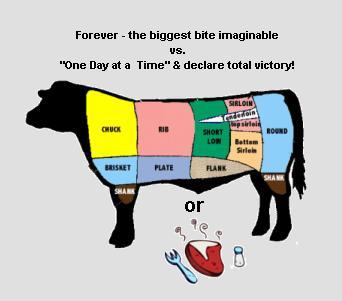
- Measuring Victory - Forget about quitting "forever." Like attempting the seemingly impossible task of sitting down to eat an entire cow or steer, it's the biggest psychological bite imaginable. Instead, like eating one nice juicy steak or hamburger a day, work hard at adopting a far more manageable "one day at a time" quitting philosophy for measuring victory. If we insist on seeing success only in terms of quitting forever then on which day will we celebrate? Who is coming to that party? (video)
- Four Recovery Layers - When quitting, the amount of nicotine remaining in your bloodstream will be cut by roughly half every two hours. Peak withdrawal normally occurs within 24 to 48 hours. Within 72 hours, all nicotine will have passed from your body and your brain will have no choice but to begin the process of restoring natural sensitivities. Now on the down-slope, the worst of physical withdrawal is behind you. Welcome to your new nicotine-free body and mind! Within 21 days your brain will have restored natural sensitivities and receptor counts. During this time, expect to come to terms with the normal emotional sense of loss. Subconscious trigger reconditioning normally peaks during the first week and all but seasonal, holiday and infrequent triggers (examples: a birth, death, wedding or serious illness) should be extinguished within a month. Conscious thoughts of wanting will gradually grow fewer, shorter in duration and generally less intense. Within a few months, they'll become the exception, not the rule, as you'll gradually start to develop an expectation of going your entire day without once wanting to inhale nicotine into your lungs and bloodstream.
- Calm Your Deep Inner Mind - The primitive subconscious mind (the lizard brain) falsely sees ending all nicotine use as though committing suicide or starving ourselves to death. The good news is that our subconscious does not think, plan or plot against us but simply reacts to years of use conditioning and to input received from the mind's priorities teacher, our nicotine-dependent dopamine pathways. Use your conscious thinking mind to calm and reassure your lizard brain, especially in the fleeting seconds before dosing off into sleep. It's then that precious moments of communication become possible as the two draw near.
- Withdrawal Symptoms - Within reason, it's fairly safe to blame most of what you'll feel during the first three days on quitting. But after that, you need to listen to your body. If you normally would have seen a doctor if not quitting, if the symptom persists, give your doctor a call. Don't blame your symptoms on where you're going but on where you've been. See each as the true sign of healing it reflects. Healing is good, not bad. (video)
- Possible Hidden Conditions - Cigarettes contain more than 7,000 chemicals including more than 70 linked to cancer. One or more of those 7,000 chemicals may have been masking an underlying hidden health problem. Inhaled chemicals may also have been interacting with medications you were taking and an adjustment may be necessary. Stay alert and if at all concerned immediately contact your physician or pharmacist. (video)
- Do Not Skip Meals - Each puff of nicotine was our spoon, releasing stored fats and glucose into our bloodstream. It allowed us to skip meals without experiencing wild blood-sugar swing symptoms such as an inability to concentrate or hunger-related anxieties. Learn to again properly fuel your body by spreading out your normal daily calorie intake more evenly. Try not to skip meals. (video)
- Three Days of Natural Juices - Unless diabetic, sip on acidic fruit juice for the first three days. Cranberry is excellent and a bottle will cost less than a pack. The acidic juices will not only aid in more quickly removing the alkaloid nicotine, it will help stabilize blood sugars. But only for three days as juices are rather fattening. (video)
- Weight Control - You'd need to gain at least 75 extra pounds in order to equal the health risks associated with smoking one pack-a-day. Eat vegetables and fruits instead of candies, chips and pastries to help avoid weight gain. Engage in some form of moderate daily exercise if at all concerned about weight. (video)
- Stress Related Anxieties - Recognize that contrary to what we felt and believed, inhaled nicotine does not relieve stress but only its own absence. Nicotine is an alkaloid. Stress is an acid-producing event capable of quickly neutralizing the body's nicotine reserves. As nicotine addicts, we added early withdrawal to every stressful event. You will soon discover an amazing sense of calm during crisis. There are a host of anxiety management techniques you can employ. (video)
- Caffeine/Nicotine Interaction - Amazingly, nicotine somehow doubles the rate by which the body depletes caffeine. Studies have found that your blood-caffeine level will rise to 203% of your normal baseline if no caffeine intake reduction is made when quitting. Although not a problem for most light to moderate caffeine users, consider a caffeine intake reduction if troubled by anxieties or if experiencing difficulty relaxing or sleeping. (video)
- Emotional Phases - Chemical dependency upon inhaled nicotine is one of the most intense, repetitive and dependable relationships you've likely ever known. It has infected almost every aspect of your life. Be prepared to experience a normal sense of emotional loss when quitting. Expect to travel through and experience six different emotional phases: (1) denial, (2) anger, (3) bargaining, (4) depression, (5) acceptance, and (6) complacency. (video)
- Subconscious Nicotine Triggers - You have conditioned your subconscious mind to expect nicotine when encountering certain locations, times, events, people or emotions. Be prepared for each to trigger a brief crave episode. Encountering a trigger cannot trigger relapse unless you take a puff. But take heart. Most triggers are reconditioned and extinguished by a single encounter during which the subconscious mind fails to receive the expected result - nicotine. (video)
- Crave Episodes Peak Within 3-5 Minutes - In contrast to conscious thought fixation (the "nice juicy steak" type of thinking that can last as long as you have the ability to maintain your focus and concentration), it is rare when any subconsciously triggered crave episode lasts longer than 5 minutes. If it should happen it could indicate that you encountered two triggers in close proximity to each other, and have the opportunity to reclaim two aspects of life.
- Expect Time Distortion - Studies teach us that nicotine cessation causes serious time distortion. Although crave episodes are usually less than three minutes, recovery time distortion can make minutes can feel like hours. Keep a clock or watch handy to maintain an honest perspective on time.
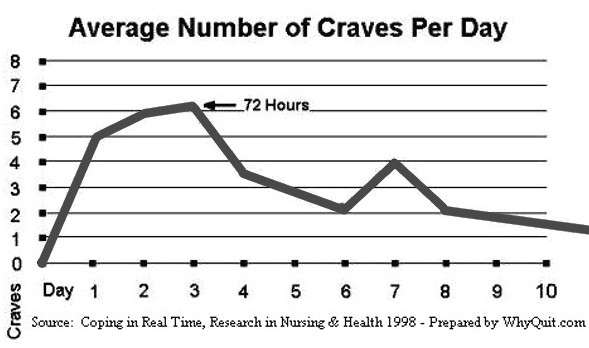
- Crave Episode Frequency - Unless hiding in a closet, you'll likely experience the greatest number of triggers around day three. The "average" smoker reports a peak of six cravings on day 3. That's a total of 18-30 minutes of challenge on their most challenging day. But what if you're not "average"? What if you established and must encounter twice as many nicotine-feeding cues as the average quitter? That's 36-60 minutes of significant challenge. Can you handle 60 minutes of serious desire in order to reclaim your mouth, mind and life? Absolutely! We all can. Be prepared for a small spike in crave episodes on day seven as you celebrate your first full week of freedom from nicotine. Yes, for most of us nicotine use was part of celebrations too. Also, stay alert for subtle differences between crave triggers. For example, the Sunday newspaper is much thicker and may have required more than one cigarette to read.
- Understanding the Big Crave - In the above-discussed cravings study, the average quitter was experiencing just 1.4 crave episodes per day by day ten. Shortly thereafter, it isn't unusual to start experiencing entire days without encountering a single un-reconditioned subconscious crave trigger. If a later crave episode ever feels far more intense, it's likely that it has been some time since your last significant challenge and you've dropped your guard and defenses a bit. It can almost feel as though you've been sucker-punched. If this should occur, stop and reflect on how long it has been since your last significant challenge. If significant, see your sucker punch as the wonderful sign of healing it reflects.
- Confront Your Crave Triggers - Recognize the fact that everything you did as a smoker you will learn to again comfortably do as an ex-smoker. Meet, greet and defeat your triggers. Don't hide from them. You need not give up anything when quitting except nicotine. As you're about to discover, everything you did as a nicotine user can be done as well or better as a non-user. With each trigger extinguished you receive a prize, another piece of a puzzle that once complete will reflect you comfortably and confidently engaging all aspects of life. (video)
- Alcohol Use - Be extremely careful with early alcohol use during the first couple of weeks. Relapse studies teach us that alcohol use is associated with roughly half of all relapses. Using an inhibition diminishing substance and then intentionally surrounding yourself with smoking smokers while still engaged in early withdrawal is a recipe for relapse. Get your quitting feet under you first. If an alcohol user, once ready to challenge your drinking triggers consider breaking the challenge down into smaller more manageable trigger segments. Consider drinking at home first without nicotine around, or going out but refraining from drinking, or spacing your drinks further apart, or drinking water or juice between drinks. Have an escape plan and a backup, and be fully prepared to use both. If a problem drinker, reflect on the possibility that you may be dealing with two issues. (video)
- Distraction Crave Coping - Distraction or diversion crave coping is any mental exercise or physical activity that occupies the conscious mind long enough to allow challenge to pass. For example, a popular 3-5 minute coping exercise is to say your ABCs while associating each letter with your favorite food, person or place. For example, the letter "A" is for grandmother's hot apple pie. "B" is for warm buttered biscuits. You may never reach the challenging letter "Q" before the challenge passes.
- Relaxation Crave Coping - Three relaxation exercises that can be practiced and called upon as nicotine cessation crave coping strategies: (1) slow deep breathing [audio exercise #1, audio exercise #2]; (2) progressive muscle relaxation [audio exercise ]; and (3) guided imagery [audio exercise]. It is not normal to breathe deeply. Most of us breathe from the chest. It's called shallow breathing. When you breathe deeply, your body takes in more oxygen and you exhale more carbon dioxide. The body "resets" itself to a more relaxed and calm state.
- Mindfulness Crave Coping - Mindfulness is the quality or state of being conscious or aware of something, a mental state achieved by focusing one's awareness on the present moment, while calmly acknowledging and accepting one's feelings, thoughts, and bodily sensations [audio exercise]. While engaging in slow deep breathing, remain aware and monitor your crave. Accept your thoughts and feelings about the crave without judging them. And see yourself as being separate from the craving.
- Embracing Craves - One mindfulness strategy is to mentally reach out and embrace your craves. A crave cannot cut you, burn you, kill you, or make you bleed. Try to be brave just once. In your mind, wrap your arms around the crave's anxiety energy and then feel as it slowly fizzles while within your embrace. Yes, another trigger bites the dust as you reclaim yet another aspect of life!
- Support Expectations - Don't expect family or friends who have never been chemically dependent themselves to have any appreciation of your challenges or the time required to achieve substantial comfort. It simply isn't fair to them or you. Find a recovered nicotine addict and ask them if they'd mind being your mentor for the next 90 days. You can also read or join and participate at Turkeyville, our Facebook support group.
- No Legitimate Excuse for Relapse - Recognize that using nicotine cannot solve any crisis. All it will do is add active drug addiction to your list of concerns. Fully accept the fact that there is absolutely no legitimate excuse for relapse, including an auto accident, financial crisis, the end of a relationship, job loss, a terrorist attack, a hurricane, the birth of a baby, or the eventual inevitable death of those we love most. Picture yourself not using nicotine through each and every step needed to overcome the most difficult challenge your mind can possibly imagine. (video)
- Conscious Thought Fixation - Unlike a less than three-minute subconscious crave episode, we can consciously fixate on any thought of wanting to use nicotine for as long as we're able to maintain our concentration. Don't try to run or hide from thoughts of wanting but instead place the thought under honest light. Flavor? If your use is about flavor then why can't you simply and easily substitute a flavor that isn't addictive? Just "one puff", "just once"? For us nicotine addicts, one is too many and a thousand never enough. Treat nicotine dependency recovery as if it were no different than alcoholism. See a bright line in the sand. Don't debate with yourself about wanting "a" nicotine fix. Instead, ask yourself how you'd feel about having "all" of them back, about returning to your old level of nicotine consumption or greater. (video)
- Reward Yourself - Consider putting aside the money that you would have spent buying nicotine and after a week or month treat yourself to something you really want. Save for a year and go on a vacation.
- Fully Commit To Going the Distance - Commitment is to decide, to pledge, and then do. It's about creating a loyal memory muscle that continues working when the justifications for quitting are no longer illuminated by the spotlight of the mind. As Joel teaches, quitting is one of the few endeavors in life where being 99% successful pretty much 100% guarantees defeat. Remain loyal to your original day #1 commitment. And don't be afraid to tell people around you that you've quit. Otherwise, any wild emotional swings during early recovery may leave them thinking you are using some form of drugs instead of coming off of one. Their understanding and support could be beneficial. Why fear or fight your healing? Embrace it. Get as comfortable as possible being temporarily uncomfortable. We promise, being home again and going entire days without once wanting to use is worth thousands of times more than the price of admission. (video)
- Avoid All Crutches - A crutch is any form of quitting reliance that you lean upon so heavily in supporting your quit that if quickly removed would likely result in relapse. Do not lean heavily upon a quitting buddy who quits at the same time as you. If not schooled in nicotine dependency recovery, their odds of successfully quitting for one year are relatively small. Instead, ask an ex-smoker or never-smoker for support, or visit free online support forums such as Turkeyville. (video)
- The Smoking Dream - Be prepared for an extremely vivid nicotine-use dream as tobacco tars released by healing tissues come in contact with vastly enhanced senses of smell and taste. See it as the wonderful sign of healing it reflects and nothing more. You're safe so long as use dreams remain nightmares. (video)
- See Marketing as Bait - Your quitting means thousands of dollars in lost profits to the nicotine industry. They don't want to lose you. See store cigarette advertising and the hundreds of neatly aligned packs and cartons for what they truly reflect - bait. Inside the pretty colored packs and among the hundreds of flavor additives is hidden what many dependency experts now consider earth's most captivating chemical. Don't be afraid to visit the store where you purchased your cigarettes. You need to meet, greet and defeat that trigger too! While there, look for the warning to teens and young adults that inhaling nicotine is extremely addictive. Sadly, there is none.
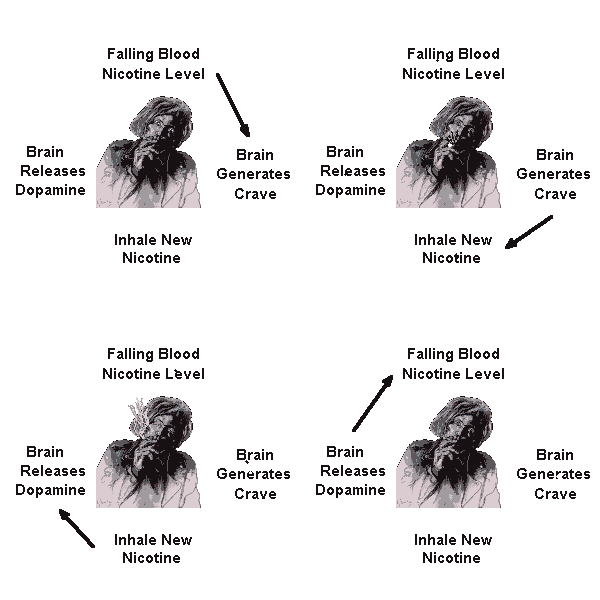
- Watch Nicotine Addicts Closely - They are not smoking, vaping, or chewing tobacco to tease you. They do so because they must, in order to replenish a constantly falling blood-serum nicotine level that declines by roughly half every two hours. Most nicotine is used while on autopilot. What cue triggered the public feeding you're now witnessing? Watch acid-producing events such as stress or drinking alcohol quickly neutralize their body's nicotine reserves. Witness their endless mandatory cycle of replenishment. (video)
- Thinking vs. Wanting - There is a major distinction between thinking about the subject of quitting and wanting to use nicotine. After years of chronic nicotine use, you should expect to notice others using nicotine but it doesn't necessarily mean that you want to. As for thoughts of wanting, with each passing day, they'll gradually grow shorter in duration, generally less intense, and a bit further apart. (video)
- Non-User or Ex-User - What should you call yourself? Although it's normal to want to see yourself as a non-user and non-smoker, there is a major distinction between a never-user and an ex-user. Only the ex-user can grow complacent, use nicotine, and relapse. "My name is ______ and while I'm a non-smoker, I prefer to refer to myself as an ex-smoker because it reminds me that I'm just one puff away from destroying one of the greatest accomplishments of my life." (video)
- Avoiding Complacency - Don't allow complacency to destroy your healing and glory. The ingredients for relapse include a failing memory of why we quit and of the early challenges, rewriting the "Law of Addiction" so as to exempt or exclude ourselves, and an excuse such as stress, celebration, illness, finances, weather, terrorism, war, death, or even a cigar at the birth of a baby. (video)
- Relapse - Remember that there are only two good reasons to inhale nicotine once you quit. You decide you want to go back to your old level of consumption (or more) and continue to gradually destroy your body and mind, or you decide that you really enjoy withdrawal and you want to make it last forever. (video)
- Only One Rule - So long as neither of the above two options appeals to you there is just one guiding principle that will 100% guarantee your continuing freedom ... no nicotine just one day at a time, Never Take Another Puff, Vape, Dip or Chew! (video)
Breathe deep, hug hard, live long!
John
This tips list was complied by John R. Polito, Nicotine Cessation Educator and Director of WhyQuit.com, a free online nicotine dependency recovery forum, primarily using articles written by Joel Spitzer, (WhyQuit.com/joel) and research available online through the National Institutes of Health (www.PubMed.gov).
Discover Smart Turkey
Knowledge is a Quitting Method