"Use relieves stress and anxiety"
Nicotine never fixed stress. It briefly eased withdrawal—as stress can make withdrawal occur sooner. Once you see the trick, this rationalization loses power.

The falsehood that nicotine relieves stress is almost as destructive as the tease of “just one.” It is also one of the hardest beliefs to discard because it was learned through powerful lived experience.
For example, a June 2013 estimate suggested that roughly one million U.S. ex-smokers relapsed after the World Trade Center attacks on September 11, 2001.[1] What is amazing is that at some point prior to 9/11, nearly all of those ex-smokers broke free despite continuing to deeply believe that nicotine was a stress-buster.
It’s natural to believe nicotine calms us during crisis. How could we not? We “felt” relief within seconds—hundreds or thousands of times. But what we felt was not stress relief.
Nicotine did not relieve stress — it relieved the withdrawal that stress had accelerated.
No Exceptions: Stress Is Not a Reason to Use
When stress spikes, the addicted brain may argue: “I need something now.” That voice isn’t wisdom. It’s the addiction trying to reopen the nicotine door.
Answer: “Nicotine never fixes stress. It only restarts withdrawal. I’m staying free.”
According to a once-secret 1983 Brown & Williamson memo, “people smoke to maintain nicotine levels” and “stress robs the body of nicotine,” implying that smokers often smoke more during stress due to withdrawal—not to relax.[2] Said differently, stress can bring withdrawal on sooner.
Here’s the mechanism: stress hormones can shift body chemistry and make urine more acidic. Nicotine is a weak base, and acidic urine speeds renal (kidney) elimination of nicotine. When nicotine levels drop sooner than expected, withdrawal arrives sooner and feels more urgent. When nicotine is reintroduced, withdrawal stops quickly—creating the illusion that nicotine calmed the stress itself.
This is why stress falsely feels “fixed” by nicotine—the body chemistry changes first, the relief is misattributed, and the brain learns the wrong lesson.
The underlying problem is still there. If the tire is flat, it is still flat. Nicotine never fixed the crisis—it only interrupted withdrawal long enough to make us believe it did.
A never-smoker and a smoker both get a flat tire in freezing rain. The never-smoker sighs and reaches for a jack. The smoker reaches for nicotine. Why? Not because nicotine solves the situation, but because stress has intensified withdrawal and the addict needs relief before anything else can happen.
Stress hormones such as cortisol can increase the kidneys’ excretion of acid, lowering urine pH.[5] Research demonstrates that nicotine clearance rises as urine becomes more acidic. In one controlled study, increasing urine acidity from pH 5.6 to pH 4.5 (about 11× more acidic) produced a 206% increase in the rate of nicotine renal elimination.[3]
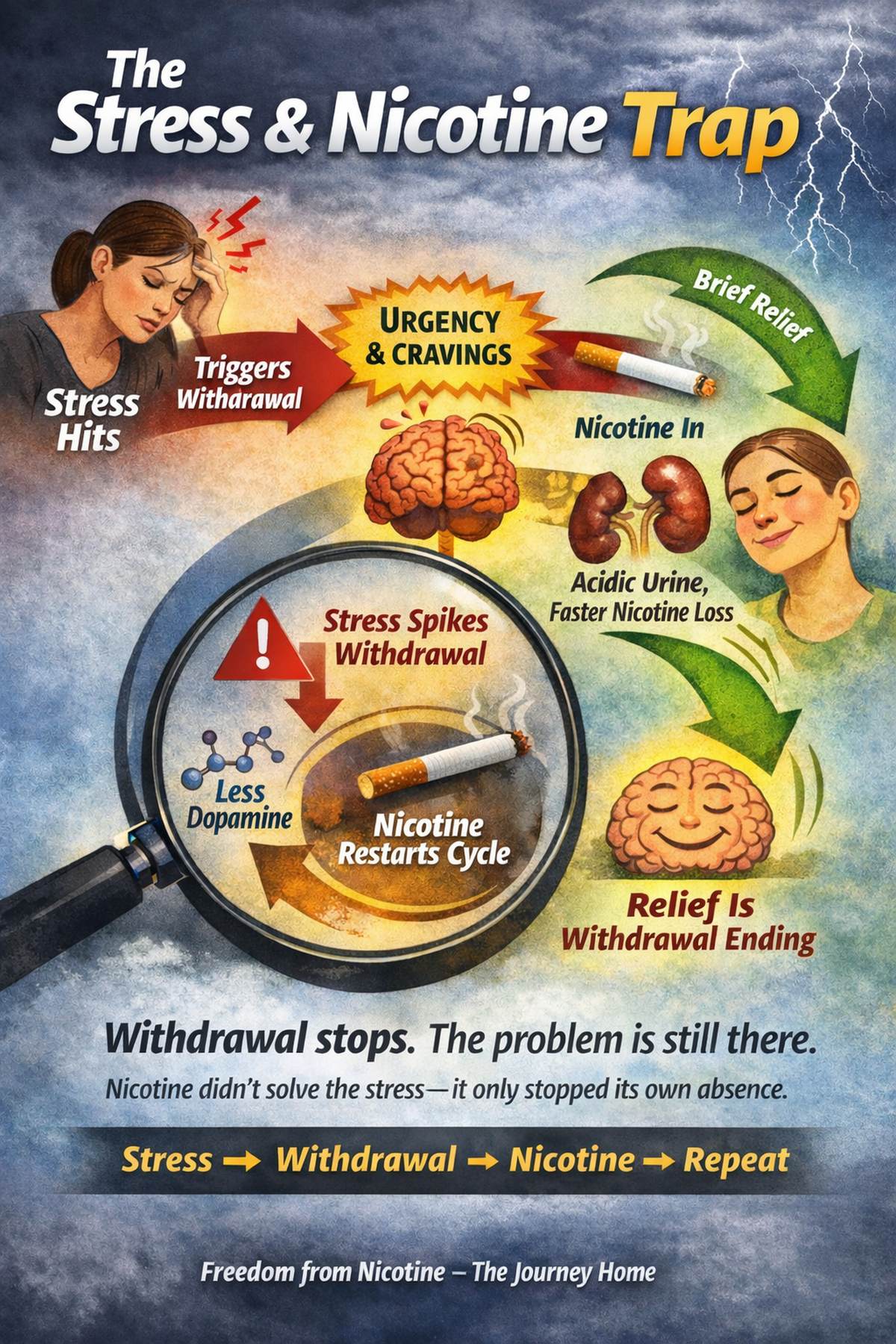
Modern neuroscience helps explain why this rationalization feels so convincing. Stress can switch on dopamine-linked craving pathways that have learned to expect nicotine relief. Translation: when stress hits, the brain may not be asking for help with the problem. It may be demanding nicotine to end withdrawal and restore the chemical dependence it remembers.[6]
If stress speeds the removal of nicotine from the body, withdrawal may arrive sooner. The addicted brain then remembers what relieved that discomfort in the past — nicotine. The stressful event itself, however, remains unchanged.
Joel Spitzer makes an important (and freeing) point: nicotine’s false calming effect can become more far-reaching than we realize. It can quietly change how a person deals with conflict, sadness, and growth by repeatedly interrupting real-world problem solving with withdrawal management.[4]
Imagine an ongoing annoyance (like the squeezed toothpaste tube example Joel shares). Each time irritation appears, withdrawal is triggered sooner, the smoker steps away to smoke, and the issue “feels” smaller afterward. It seems resolved— but it wasn’t addressed. Over years, unresolved stress accumulates. After quitting, those feelings can finally surface— not because quitting created them, but because nicotine had been suppressing them.
The lasting solution is not nicotine. The lasting solution is arresting nicotine dependency. And as you do, it helps to quickly discard the destructive falsehood that a stimulant ever brought calm.
One Rule
No nicotine today.
When stress argues for nicotine, treat it as relapse talk—not a debate. Step away, breathe, move, and use Urge Help until the moment passes.
References:
- Caba, J, 9/11 Attacks Made 1 Million Former Smokers Pick Up Cigarettes Again, MedicalDaily.com, Jun 21, 2013. ↩
- Brown & Williamson Tobacco Corporation, Internal Correspondence, March 25, 1983, Bates Number: 670508492. ↩
- Benowitz NL, Jacob P 3rd, Nicotine renal excretion rate influences nicotine intake during cigarette smoking. Journal of Pharmacology and Experimental Therapeutics, July 1985, Volume 234(1), Pages 153-155. ↩
- Spitzer, J, New Reactions to Anger as an Ex-smoker, an article in Joel's free PDF book Never Take Another Puff, https://whyquit.com/joel/ ↩
- Nagami GT, et al. The Role of the Endocrine System in the Regulation of Acid–Base Balance by the Kidney and the Progression of Chronic Kidney Disease. Cells. 2024. (See section on glucocorticoids increasing net acid excretion and ammonia secretion by the kidney.) https://pmc.ncbi.nlm.nih.gov/articles/PMC10889389/ ↩
- Wang X, Chen Y, Dong J, Ge J, Liu X, Liu J. Neurobiology of stress-induced nicotine relapse. International Journal of Molecular Sciences. 2024;25(3):1482. doi:10.3390/ijms25031482. PubMed: 38338760. https://pubmed.ncbi.nlm.nih.gov/38338760/ ↩