“Nicotine Is Basically the Same as Caffeine.”
When this claim pops up during withdrawal, it often isn’t trying to educate you — it’s trying to reopen the door. Here’s a fast reality check that protects healing and recovery.
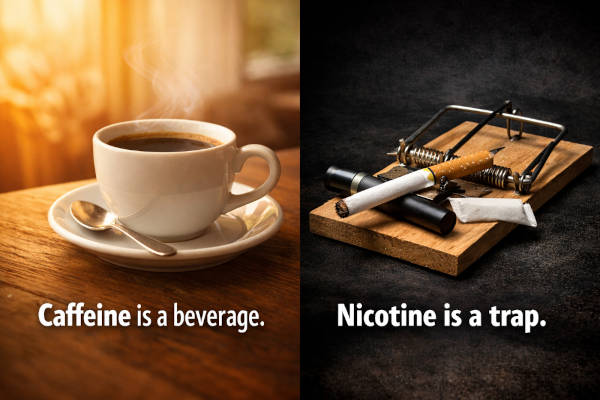
This is one of the most common nicotine-use permission thoughts. It sounds reasonable, even scientific, and it’s often voiced right when withdrawal is asking for relief. But it isn’t true in the ways that matter most. While nicotine and caffeine can both be called “stimulants,” that label hides the real issue: their ability to take control of behavior.
Many people can skip caffeine and feel little or nothing. Some feel a mild headache or temporary “flat” mood, and then life moves on. Caffeine can be a routine — even a dependency for some — but it rarely trains the brain to treat dosing as an emotional emergency. Most caffeine users don’t find themselves bargaining, justifying, or feeling compelled to re-dose to make distress stop.
Nicotine is different — as different as night and day. Nicotine doesn’t merely “wake you up.” It pairs itself with relief, focus, calm, reward, and coping, until the subconscious starts treating nicotine as needed. That’s why early recovery can feel urgent and personal: not because something new is wrong, but because an old drug-training program is being switched off.
Reality check
- Nicotine is a re-dosing drug. It trains “more” — more often, in more moments, for more reasons. Caffeine usually doesn’t.
- Nicotine is cue-bound. Stress, boredom, driving, phone scrolling, after meals, social moments — nicotine links itself to cues and then demands a response.
- Nicotine is relapse-sensitive. With nicotine, “just once” can quickly reactivate a sleeping pathway that begins negotiating for the next dose.
- The comparison shows up as permission. It doesn’t arrive to educate you. It arrives to soften resolve and reopen the door.
If nicotine were “just caffeine,” ending use wouldn’t trigger urgent bargaining. You wouldn’t hear thoughts like “I deserve it,” “I’ll start again tomorrow,” or “just this once.” That inner debate is the giveaway: it’s not about chemistry trivia — it’s about protecting recovery.
If this claim pops up in your mind today, treat it as a symptom, not a truth. Let it pass. Keep healing. Keep coming home. No nicotine today protects everything your brain is rebuilding.